
Does spatial audio actually help in FPS games?
Just about every gaming headset on the market mentions spatial audio, 3D audio, or surround sound somewhere on the box. It reads like marketing language, and plenty of players assume that's all it is.
So, what is spatial audio actually doing to the sound that reaches your ears, and does it give you anything you can genuinely use in a shooter?
TL; DR:
- Spatial audio uses HRTF processing to place sounds anywhere in 3D space around you – above, below, in front, behind – rather than only left and right the way plain stereo does.
- In an FPS this turns audio into usable information, letting you hear roughly where an enemy is before they appear on screen.
- How convincing the effect is depends on both the processing and the drivers playing it back, which is why two headsets with similar feature lists can position sound very differently.
How you locate sound in the real world
Before the technology makes much sense, it helps to look at how your own hearing works, because spatial audio is built to imitate it.
Your brain uses a handful of cues to work out where a sound came from. A noise off to your right reaches your right ear a fraction of a millisecond before it reaches your left, and it arrives slightly louder. Those two differences, timing and volume, are enough for your brain to place that sound somewhere on your right side.

Left and right is the easy part, though. The harder question is whether something is in front of you or behind you, above or below, and that one gets answered by the shape of your outer ear. Your ear filters incoming sound differently depending on the angle it arrives from, and your brain has spent your entire life learning what those filtered versions sound like. It reads the filtering and fills in the rest of the position for you, instantly, without you ever noticing it happening.
What spatial audio actually does
Spatial audio recreates those cues artificially. At the center of it is something called a "head-related transfer function," or HRTF, which is essentially a model of how a sound changes on its way to your eardrum based on the direction it's traveling from.
Run a sound through the right HRTF and it picks up the same filtering a real sound would carry if it were coming from that spot. Your brain then does what it always does and places it there. A sound rendered as "above and to the left" is heard above and to the left, even though it's reaching you from a pair of drivers sitting a couple of centimeters from your ears.
Compare this with plain stereo, which simply pans sound between two channels. That gives you left and right and not much else; front and back tend to blur together, and height disappears almost entirely. Spatial audio puts those missing dimensions back by processing every sound according to where it's supposed to be coming from.

Where it matters in an FPS
This is the point where it stops being theory. A shooter's game engine already knows the exact 3D position of every sound source in the level. Footsteps on the floor above, a reload behind a wall, gunfire two rooms over, all of it has coordinates attached.
Spatial audio takes those coordinates and renders each sound where it actually sits relative to your character. An enemy flanking from behind sounds like they're behind you. Someone moving upstairs sounds like they're above you. In titles like Counterstrike 2, Valorant, Apex Legends, or Rainbow Six Siege, where the sound design is detailed enough to reward listening carefully, that's information arriving through your ears before anything appears on your screen.
So, does it actually help? For positional awareness, yes. Hearing a reload around a corner, or footsteps closing in from a specific direction, buys you reaction time you would not get from a flat stereo mix. It's directional data you can act on. And the first time a good spatial setup has you turning your head to check a room you aren't physically standing in, it stops feeling like a spec on a box.
It also changes how games feel outside of competitive play. Firefights gain depth, and weather and ambience sit around you instead of being pushed flat in front of your face. The world stops feeling like a screen with sound attached to it and starts feeling like a space you're standing inside.
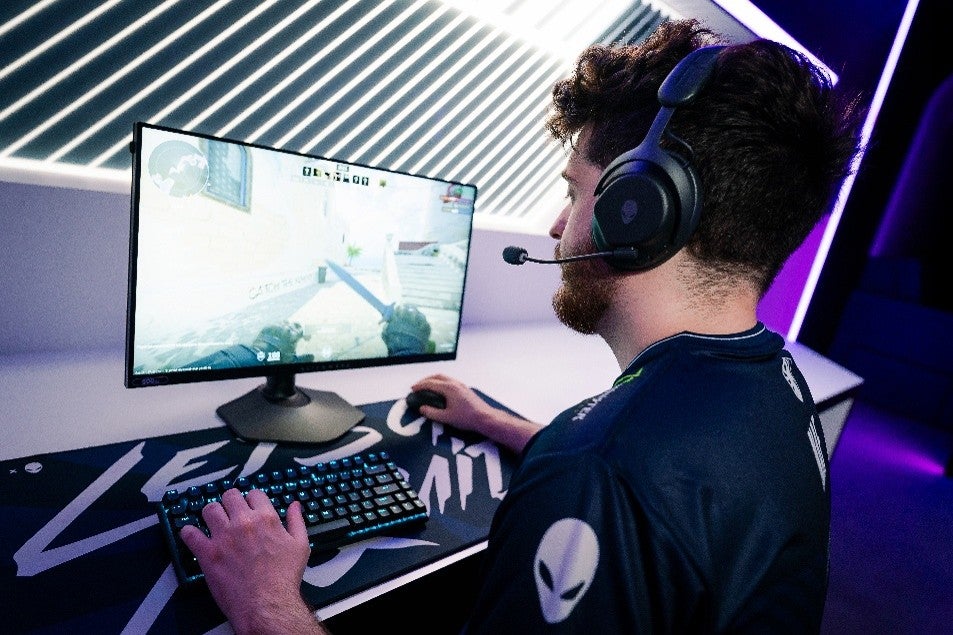
What does all this mean when you're playing?
Good spatial audio comes down to two things working together: processing that model’s direction convincingly, and drivers clean enough to keep every sound distinct rather than letting footsteps get buried underneath gunfire. Get both of those right and you stop simply hearing the game and start hearing where everything in it is.
Shop the Alienware Pro Headset, with Dolby Atmos Spatial Audio Here: Alienware Pro Wireless Gaming Headset | Dell USA